



Principais conclusões
Se você busca proteção contra quedas e telas trincadas, o vidro temperado é a solução. As películas protetoras líquidas oferecem resistência a arranhões do dia a dia por até um ano, sendo uma excelente opção para usuários cuidadosos que preferem uma camada invisível para manter a tela impecável.
| Vidro temperado | Protetor de tela líquido | |
| Proteção contra quedas | Forte | Limitado |
| Resistência a riscos | Dureza 9H, excelente | Bom para uso diário. |
| Toque Sinta | Suave, com espessura ligeiramente aumentada. | Natural, inalterado |
| Clareza da tela | Alta definição, imagem cristalina | Invisível, transmissão de luz superior a 95%. |
| Instalação | Pode reter poeira e bolhas. | Requer aplicação cuidadosa. |
| Durabilidade | Dura até rachar ou ser substituído. | Dura até 1 ano e desaparece gradualmente. |
| Ideal para | Usuários que carregam o produto diariamente e são propensos a quedas. | Volume mínimo, uso leve |
Tanto as películas protetoras líquidas quanto as de vidro temperado prometem proteger seu celular, mas oferecem proteção contra coisas diferentes. Escolha a errada e você ainda pode acabar com a tela trincada. Aqui está uma análise detalhada sobre proteção, instalação, durabilidade e custo.
Qual a diferença entre protetores de tela líquidos e vidro temperado?
película protetora de vidro temperado É uma fina e rígida lâmina de vidro temperado que fica sobre a tela. Ela age como uma barreira física que absorve o impacto e retém os danos em vez de danificar o visor. Sua espessura geralmente varia de 0,3 a 0,5 mm.
Protetores de tela líquidos São uma solução de dióxido de silício aplicada diretamente na superfície da tela. O líquido adere em nível microscópico e cura, formando um revestimento duro e invisível. Sem camada visível, sem bordas, sem moldura.
Se você estiver comparando apenas esses dois, também é útil saber que existem películas de PET e TPU como alternativas. O PET oferece resistência básica a arranhões a baixo custo; o TPU adiciona flexibilidade e absorção de impactos leves. Ambos são removíveis e mais baratos que o vidro temperado, mas oferecem menos proteção geral. Este artigo se concentra na comparação entre películas líquidas e vidro temperado, pois representam extremos opostos no espectro de proteção.
Principais diferenças estruturais
- O vidro temperado adiciona uma camada física removível. As películas protetoras líquidas tornam-se parte da superfície da tela.
- O vidro temperado pode ser substituído quando danificado. Revestimentos líquidos não podem ser removidos após a aplicação.
- As películas protetoras líquidas cobrem toda a tela, incluindo as bordas curvas. O vidro temperado pode deixar pequenas folgas em telas curvas.
Qual delas oferece melhor proteção contra quedas e arranhões?
Resistência a riscos
Ambas as opções resistem a arranhões do dia a dia causados por chaves, moedas e areia.
O vidro temperado é classificado 9H Na escala de dureza de lápis, um padrão forte e verificável. Protetores líquidos também melhoram a dureza da superfície, mas não conseguem igualar a espessura física do vidro temperado contra objetos pontiagudos.
Algumas fórmulas de protetores líquidos incluem aditivos auto-reparadores que permitem que pequenos arranhões superficiais desapareçam com o calor ao longo do tempo.Isso compensa parcialmente a vulnerabilidade a arranhões, embora não se aplique a danos profundos ou causados por objetos pontiagudos.
Proteção contra quedas
Quando seu telefone cai no chão, a película de vidro temperado absorve e distribui a energia do impacto, trincando-se em vez de quebrar a tela. É um sistema de proteção contra impactos. camada sacrificial.
As películas protetoras líquidas funcionam de maneira diferente. Elas formam uma camada ultrafina sobre a superfície do vidro, mas não adicionam uma camada física capaz de absorver ou redistribuir a energia do impacto. Consequentemente, geralmente não são consideradas uma proteção eficaz contra danos causados por quedas.
Comparação lado a lado
| Tipo de proteção | Vidro temperado | Protetor Líquido |
| Arranhões do dia a dia | Excelente | Bom |
| arranhões de objetos pontiagudos | Excelente (9H) | Moderado |
| Absorção de gotas | Forte | Mínimo |
| Prevenção de tela trincada | Alto | Baixo |
| Cobertura de bordas e curvas | Parcial em telas curvas | Completo |
Como cada opção afeta a sensação ao toque e a qualidade da tela?
Toque Sinta
As películas de vidro temperado adicionam uma fina camada física, que alguns usuários percebem como um leve aumento na altura da superfície nas bordas. A superfície do vidro em si é lisa e possui excelente sensibilidade ao toque.
As películas protetoras líquidas preservam completamente a sensação original da sua tela. Como a camada não adiciona espessura perceptível, deslizar e tocar na tela são praticamente idênticos aos de um telefone sem proteção.
Visibilidade da tela e impressões digitais
As películas protetoras de vidro temperado oferecem alta definição e clareza quando limpas, sem alteração de cor ou embaçamento. O vidro temperado de alta qualidade inclui um revestimento oleofóbico para resistir a manchas, embora esse revestimento se degrade com o uso ao longo do tempo e as impressões digitais possam ficar mais visíveis.
As películas protetoras líquidas são praticamente invisíveis, com mais de 95% de transmissão de luz. As cores e o contraste parecem naturais, e não há bordas ou contornos visíveis que distraiam a atenção da tela.
É mais fácil aplicar uma película protetora líquida do que uma de vidro temperado?
Aplicação de um protetor líquido
Você espalha a solução uniformemente na tela, deixa secar e remove o excesso com uma toalha. A aplicação irregular resulta em listras, e não há como verificar o alinhamento durante o processo.
Porque revestimentos líquidos vínculo permanente Na superfície da tela, os erros não podem ser corrigidos após a cura e o revestimento não pode ser removido completamente sem risco de danos.
Aplicação de vidro temperado tradicional
A poeira que se deposita no lado adesivo cria bolhas permanentes. Erros de alinhamento resultam em bordas salientes ou recortes desalinhados. Muitas pessoas acabam com uma película protetora que parece perfeita na caixa, mas fica torta no celular.
O problema da poeira e das bolhas
Mesmo em um ambiente limpo, a poeira se deposita no adesivo nos segundos entre a remoção da película protetora e a pressão sobre o vidro. Os kits padrão incluem adesivos para remover poeira, mas eles não capturam tudo.
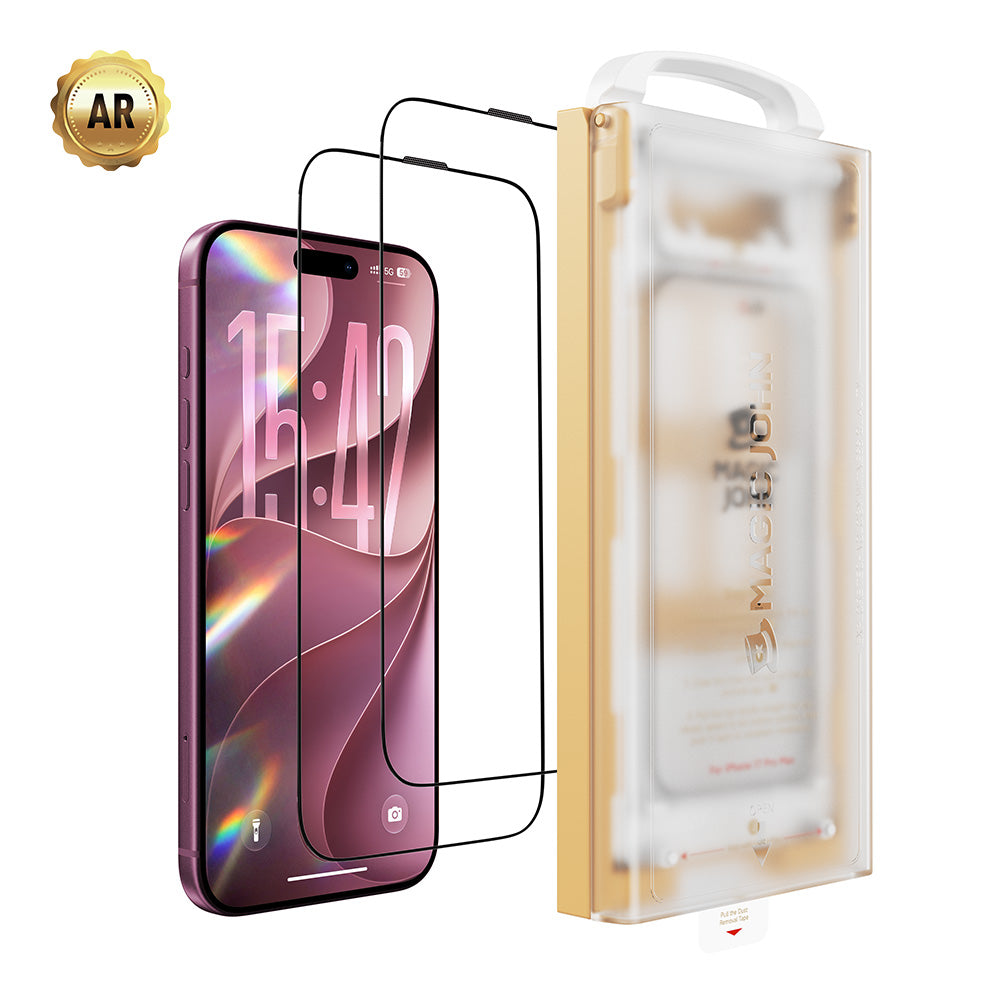
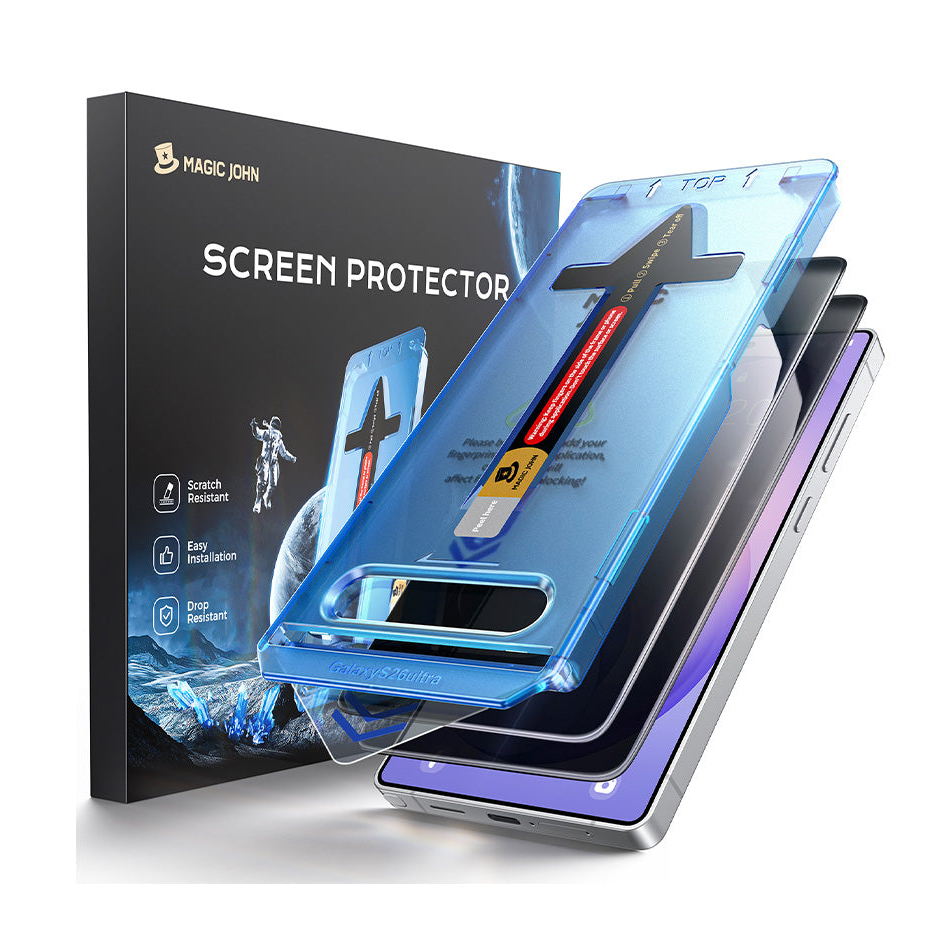
MAGIC JOHN'S Protetores de tela de 3ª geração use um aplicador automático de remoção de poeira. A bandeja remove partículas antes que o vidro entre em contato com a tela. A instalação em uma única etapa alinha e aplica com um único puxão. Sem poeira, sem bolhas, sem necessidade de refazer o processo.

Protetor de tela líquido vs. vidro temperado: prós e contras
Vidro temperado
Prós
- Absorve o impacto da queda como uma camada de sacrifício.
- A dureza 9H resiste a arranhões do dia a dia e de objetos pontiagudos.
- Trincado? Troque o vidro, não o kit inteiro.
- Tela cristalina sem distorção de cores.
Contras
- Pode haver formação de poeira e bolhas durante a instalação.
- As impressões digitais tornam-se mais visíveis à medida que o revestimento oleofóbico se desgasta.
- Pode deixar pequenas folgas em telas altamente curvas.
Protetor de tela líquido
Prós
- Completamente invisível, sem bordas ou contornos.
- Cobertura total em telas curvas
- A tela está exatamente como antes.
- Algumas fórmulas autorreparam pequenos arranhões com calor.
Contras
- Sem proteção contra quedas; a tela permanece vulnerável a rachaduras.
- Adere permanentemente à tela e não pode ser removido sem deixar resíduos.
- O efeito desaparece em seis a doze meses sem deixar sinais óbvios.
- Erros cometidos durante a inscrição não podem ser corrigidos.
Qual a durabilidade de uma película protetora de tela e qual delas oferece o melhor custo-benefício a longo prazo?
Vida útil
O vidro temperado dura até quebrar. Quando isso acontece, você substitui apenas o vidro, não o kit completo.
Os protetores líquidos degradam-se gradualmente. Com o uso diário médio, o revestimento normalmente dura por seis a doze meses antes que a dureza da superfície e as propriedades hidrofóbicas comecem a diminuir. Não há um ponto de ruptura claro. Simplesmente deixa de funcionar tão bem com o tempo.
Custo a longo prazo
Protetores líquidos podem parecer baratos à primeira vista. No entanto, ao considerar a necessidade de reaplicação a cada seis a doze meses e a proteção limitada contra quedas que oferecem, o custo-benefício geral dessa proteção é inferior ao do vidro temperado no mesmo período. Os kits MAGIC JOHN Gen 3 incluem dois protetores e um... bandeja aplicadora reutilizável, o que reduz ainda mais o custo por unidade para usuários que desejam uma opção confiável a longo prazo.
Quem deve usar uma película protetora líquida e quem deve usar uma película de vidro temperado?
Escolha vidro temperado se:
- Você deixa seu celular cair com frequência ou o carrega sem capa.
- Você quer uma proteção que seja visível, verificável e substituível.
- Você usa seu telefone em ambientes ativos ou ao ar livre.
- Você deseja proteção duradoura sem necessidade de reaplicação programada.
Escolha um protetor líquido se:
- Seu telefone possui uma tela altamente curvada, onde o vidro temperado deixa espaços visíveis.
- Você quase nunca deixa seu celular cair.
- Você prioriza um acabamento invisível, sem bordas ou contornos visíveis.
Se a instalação foi o problema
Muitas pessoas optam por protetores líquidos por frustração com bolhas e desalinhamento, e não por preferirem o nível de proteção. A questão é o método de instalação, não o tipo de produto. aplicador automático sem poeira Resolve o problema de instalação sem abrir mão da proteção do vidro temperado.
Encontre a película protetora ideal para o seu celular.
O vidro temperado oferece uma proteção significativamente maior contra quedas e é a melhor opção para a maioria das pessoas. As películas de vidro temperado de 3ª geração da MAGIC JOHN cobrem... iPhone 12 através de 17 séries e Samsung Galaxy S24 até S26. Encontre o seu na MAGIC JOHN.
Perguntas frequentes
P1: Posso usar uma película protetora líquida e uma película de vidro temperado ao mesmo tempo?
Sim. Aplique primeiro a película protetora líquida e, em seguida, coloque o vidro temperado por cima. O revestimento preenche imperfeições microscópicas da superfície, o que pode melhorar a adesão e a resistência a riscos. É um benefício adicional pequeno, não uma melhoria significativa na proteção contra quedas.
P2: Uma película protetora líquida funciona?
Funciona para resistência a arranhões, não para proteção contra quedas. O revestimento de dióxido de silício endurece a superfície da tela e resiste a chaves, moedas e outros objetos do dia a dia. Não absorve o impacto de quedas e não impedirá que a tela quebre se o seu telefone bater em uma superfície dura.
P3: Como sei quando a minha película protetora líquida para tela se desgastou?
O revestimento se degrada gradualmente ao longo de seis a doze meses, sem sinais visíveis. Um teste prático: se a água não formar mais gotas na tela, a camada hidrofóbica e o revestimento protetor se desgastaram. A reaplicação restaura ambos.
Q4: A película de vidro temperado funciona com uma capa de celular?
A maioria das películas de vidro temperado é compatível com capas padrão. Capas que cobrem toda a extensão do aparelho, com bordas elevadas, podem, às vezes, levantar os cantos da película com o tempo. Se você usa uma capa protetora grossa, verifique se as dimensões da película correspondem exatamente ao modelo do seu celular para evitar que as bordas se levantem.
Q5: A dureza 9H é a mesma em protetores de película líquida e em protetores de vidro temperado?
Não exatamente. O vidro temperado 9H é testado em um material rígido sob condições padronizadas. Protetores líquidos que alegam 9H referem-se ao tratamento da superfície do revestimento. A resistência a riscos é comparável. A proteção contra impactos, não.
Q6: Existem outros tipos de protetores de tela além de líquidos e de vidro temperado?
Sim. As películas de PET são finas folhas de plástico que oferecem proteção básica contra arranhões a baixo custo e são fáceis de substituir. As películas de TPU utilizam plástico flexível que pode absorver impactos leves e geralmente possui propriedades de autorregeneração. Ambas são alternativas mais leves, embora nenhuma delas se compare ao vidro temperado em termos de proteção contra quedas.


Deixe um comentário
Este site é protegido por hCaptcha e a Política de privacidade e os Termos de serviço do hCaptcha se aplicam.